

On 7 July ten of us gathered at one member’s house.
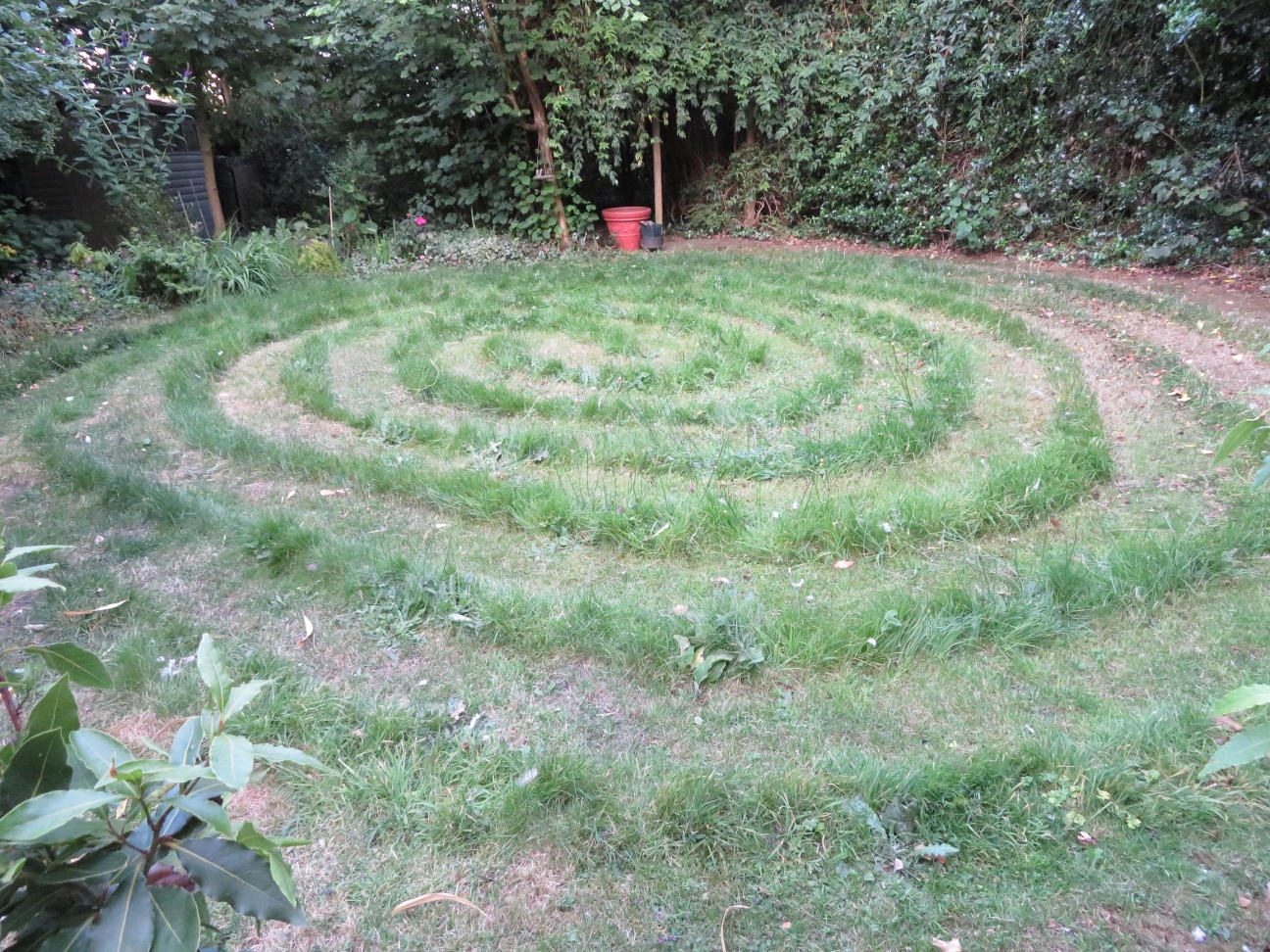
The host introduced us to the meaning of labyrinth, the distinction and confusion between labyrinths and mazes, the mythology and history (illustrated with a good set of photos), the resurgence and importantly the benefits of slow, contemplative meandering through a labyrinth – demonstrated by a wander through her very own example in the lawn of their delightful garden.
A labyrinth is a bounded interior space clearly defined from exterior space with one continuous meandering path to the centre and back out, usually by the same route. It is unicursal.
A maze by contrast is multicursal (branches) and is designed to confuse.
The classical labyrinth is the “7-circuit”. The word comes from the Greek “labyrinthos”.
Labyrinths appear through the ages, carved in stone, etched, mosaic, paved……
Their famous association is with the mythological labyrinth built by King Daedalus for King Minos of Crete to contain the Minotaur.
An example is on the floor at the Cathedral of Chartres.
It can be a substitute for making a pilgrimage (sometimes on the knees), in contemplative prayer.
In the Baltic there are double spiral labyrinths which fishermen walked before setting sail to ensure favourable winds and good catches and befuddle trolls.
Hampton Court maze is trapezoid, it pre-dates the one at Versailles.
Today labyrinths are designed for walking meditations – walking slowly, contemplatively.
May 1 2027 will be the 18th World Labyrinth Day – “to walk as one at one o’clock local time to create peaceful energy”.
Our member’s labyrinth was mown in their lawn by her husband for her to unwind after work.
It was a delight to wander it together at the end of the evening.