
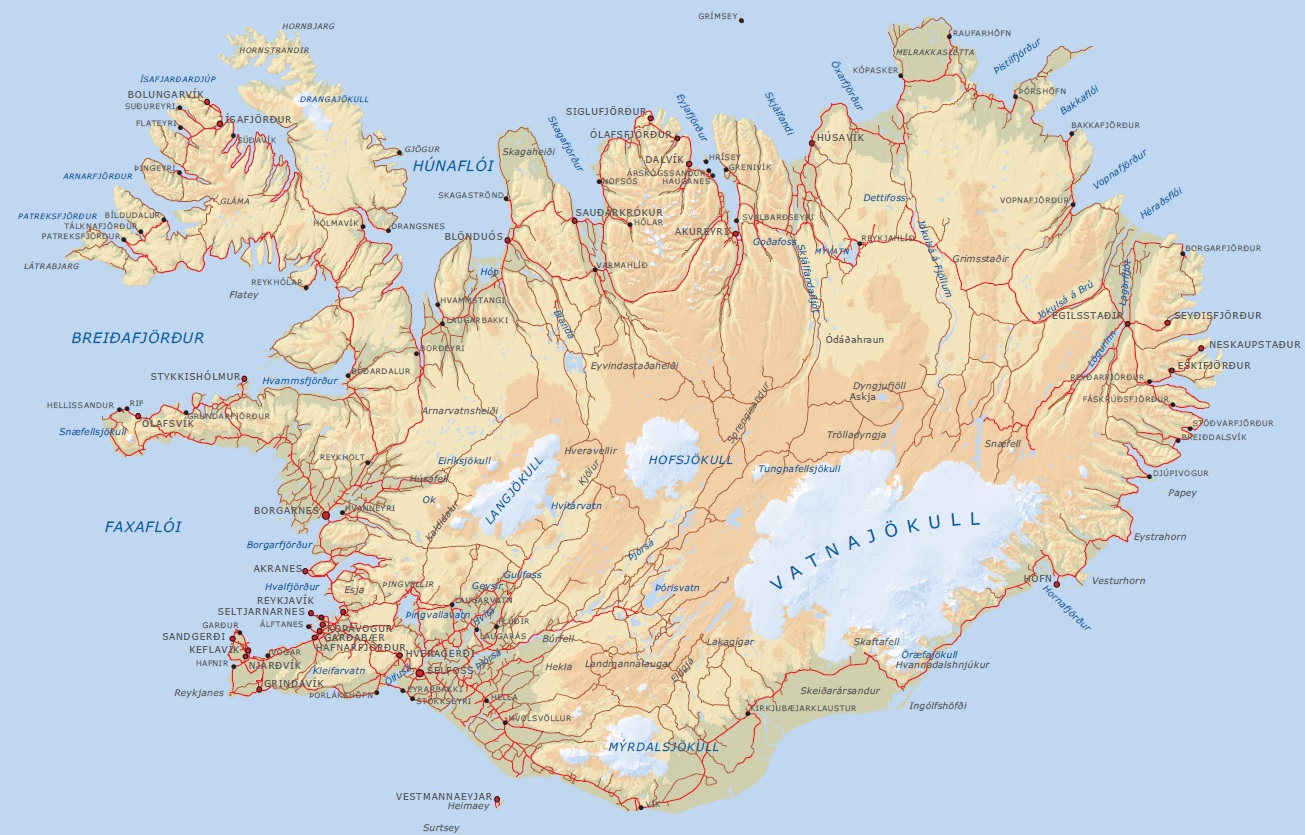

We had a good evening 29 April on the topic of Iceland, with plenty of varied contributions.
We started with an absent member’s comment that she had a wonderful time there in June 1982 & was so inspired by the landscape, natural features, wildlife & society.
The leader introduced some outline themes about Iceland – “land of fire and ice”, geology, geothermal and hydro-electric power providing almost all of heating and electricity, people, history, government, flag…… It is interesting to note that Iceland had the first elected female head of state in the world, in 1980, and currently both president and PM are female. Education including college and healthcare are both free.
Next came notes from someone unable to join us. She researched climate change – Iceland as the “canary in the coal mine” – collapsing glaciers especially since 2000, fresh water from melting ice could slow down the Gulf Stream, more volcanic eruptions because of decreasing pressure from glaciers on earth’s crust, bird population struggling, ocean acidification, record temperatures, land instability, more mosquitoes??
Are there any benefits? – more hydro-power, but will tail off when glaciers vanish; the land may become greener!
Iceland’s emission profile is unusual. It’s already ahead in renewables so there is less scope for change and it is vulnerable to the consequences of emissions elsewhere on the planet.
The next contributor told us how naming conventions work – no real surnames, just suffixes to father’s first name; phone books listed by first name; long approval process to use a name not on the approved list!
Odd fact – 10%of population have published a book!
Her brother lived on the north coast for 7 years from 2001, setting up a computer facility.
Another member commented further on names – women keep their name on marriage; now sometimes children are named as the “sson” or “dottir” of the mother.
She also supplied a series of photographs showing natural features such as volcanoes, hot springs, geysers (including one that went off every 15 minutes), black sands. waterfalls and also buildings.
A member on-line talked of the banking crisis in 2009 when Iceland allowed 3 major banks to fail, rather than prop them up like other governments. They showed a feminine attitude to risk and thus stabilised the economy. Women’s roles became prevalent in government.
She also talked of her experience of scuba-diving near Silfra, where 2 tectonic plates meet and can be touched at the same time. Water temperature is cold, constant around 2-5 degrees. Air temperature may be much lower. A dry suit is required, completely waterproof. Over the age of 60 one needs medical permission to dive here! Visibility is good – over 100m – but no fish in the fresh water.
Another member showed her 25th anniversary photo album from a trip to Iceland and the diary she kept. She still has the traditional warm cape she acquired then and showed it to us. New Year’s Eve there demonstrated a casual attitude to setting off fireworks! She recommended the film “Woman at War”.
Lastly someone recalled the wonderful colour of lupins on the hills – a fitting note on which to end.