


I ought to prefix October’s Wednesday Walk title with ‘wet’. Damp, overcast and actual rain accompanied the first half of the walk which saw us depart from Halfleet on the edge of MD. We followed Pam’s Plan B road route avoiding muddy field footpaths. Luckily we didn’t get far before Florence could be heard shouting and running after us. We failed in our first rule… “depart with everyone safely in tow!”
Pam’s route led us north along the A15 to Langtoft village. The traffic was quite a distraction and we were glad to reach the village centre for some anecdotes about the village.
The settlement of Langtoft derives from Old Norse and suggests it was Lang’s Homestead [toft] part of a group of settlements including Deeping and Baston mentioned in the Anglo-Saxon Chronicles.
The Anglo Saxon Chronicle was written in the 9th century AD during King Alfred’s reign 871–899 incorporating material from sources over 200 years earlier. The original was copied and distributed to the monasteries, where each one was independently updated over time. They are all in the form of annals: the earliest is dated 60BC relating the invasion by Julius Caesar and the newest 1154AD. Nine manuscripts of the Chronicle, none of which is the original, survive in whole or in part. Seven are held in the British Library, one in the Bodleian Library in Oxford, and the oldest in the Parker Library of Corpus Christi College, Cambridge.
The chronicle as it relates to Langtoft, Deeping and Baston depicts Earl Edwin recruiting men from the settlements to fight against the Danes. History tells us that the Danes won a sweeping victory in Kesteven whilst the people hid in the fen until danger had passed. They would have returned to their burned and pillaged settlements to rebuild and resume life. A life which prospered under King Canute (1016 to 1035) especially as part of the North Sea Empire 1018-1035 when Canute the Great was king of England and Denmark and Norway until his death.
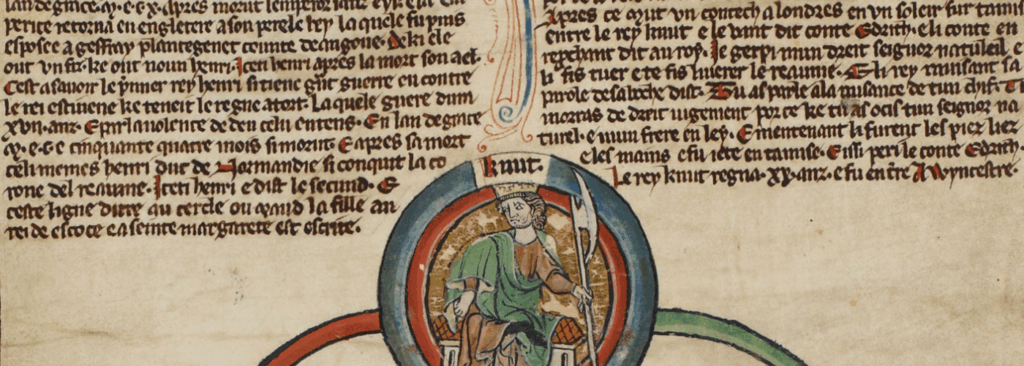
Son of Sweyn, Canute (or Cnut) became undisputed King of England in 1016, and his rivals (Ethelred’s surviving sons and Edmund’s son) fled abroad. In 1018, the last Danegeld of 82,500 pounds was paid to Canute. Ruthless but capable, Canute consolidated his position by marrying Ethelred’s widow Emma (Canute’s first English partner – the Church did not recognise her as his wife – was set aside, later appointed regent of Norway). During his reign, Canute also became King of Denmark and Norway; his inheritance and formidable personality combined to make him overlord of a huge northern empire.
King Harold Godwinson met Harald Hardrada in battle at the Battle of Stamford Bridge, York on September 25, 1066, where Harold defeated the invading Norwegian forces and killed both Hardrada and Harold’s brother, Tostig Godwinson. They took men from Kesteven and travelled on the Great North Road. Harold went on to Hastings where he was defeated by William of Normandy’s invading army.
Of course you might be enjoying this period in English history through the BBC lens of King and Conqueror starring James Norton and Nikolaj Coster-Waldau.
https://www.bbc.co.uk/writers/blog/king-and-conqueror#:~:text=King%20and%20Conqueror.-,Michael%20Robert%20Johnson,and%20add%20to%20your%20Watchlist
All this walking and historical talking made us long for the refreshments. Not the usual café prospect this time. Pam took us to the best kept secret in Market Deeping – https://cafeateventus.co.uk/about/ a bustling café on the ground floor of the Eventus centre, owned by Lincolnshire County Council, it is a serviced office complex that houses 34 businesses and more than 100 virtual tenants.
We had to wrestle for a table – the place was packed out. No wonder the chefs were serving up platefuls of steaming pie, mash, gravy and vegetables for a very reasonable amount. We all enjoyed the usual beverages and of course cake. Pam even had a choice of GF alternatives!!!

Needless to say a lovely time, despite the weather.