
We chose a 30 degree day to stroll amongst some of Grantham’s historic streets : Castlegate, Swinegate and the corner with Vine street where the Blue Pig pub is situated in a medieval timber-framed building and Bluegate leading back to Castlegate and the Beehive pub. An iconic 16th-century pub, famous as the only pub in England with a “living sign,” it features an actual, council-protected beehive situated aloft in a living Lime tree growing on the pavement outside that has been active since at least 1783.
I remember from my days at university in York, the origin of the word ‘gate’ (pronounced garter) is the old Norse word for ‘street’. Hence we were walking along streets named after their former uses: Castle street and Pigs street; named from the Old English word swin, which literally means “pigs”.
Grantham has had, in its history, pubs named the Blue Pig, the Blue Lion, the Blue Horse, the Blue Dog, the Blue Bull, the Blue Cow, the Blue Ram, the Blue Sheep, the Blue Lamb, and the Blue Man. (And the small street, Blue Gate.) These names have their roots in a 19th-century political rivalry over the membership of Parliament for the Grantham constituency between the Manners family (the Duke of Rutland, Belvoir Castle) and the Brownlow family (Belton house). Pubs in the constituency declared political allegiances, and acted as gathering places for supporters of political factions. Where a person drank declared that person’s political views. The Manners family were Whigs and chose blue as their colour. They bought several pubs and inns in the constituency, and added “blue” to their names. People could drink “blue ale” in the “blue” pubs, which was an inducement to vote for Whig candidates in the parliamentary elections.
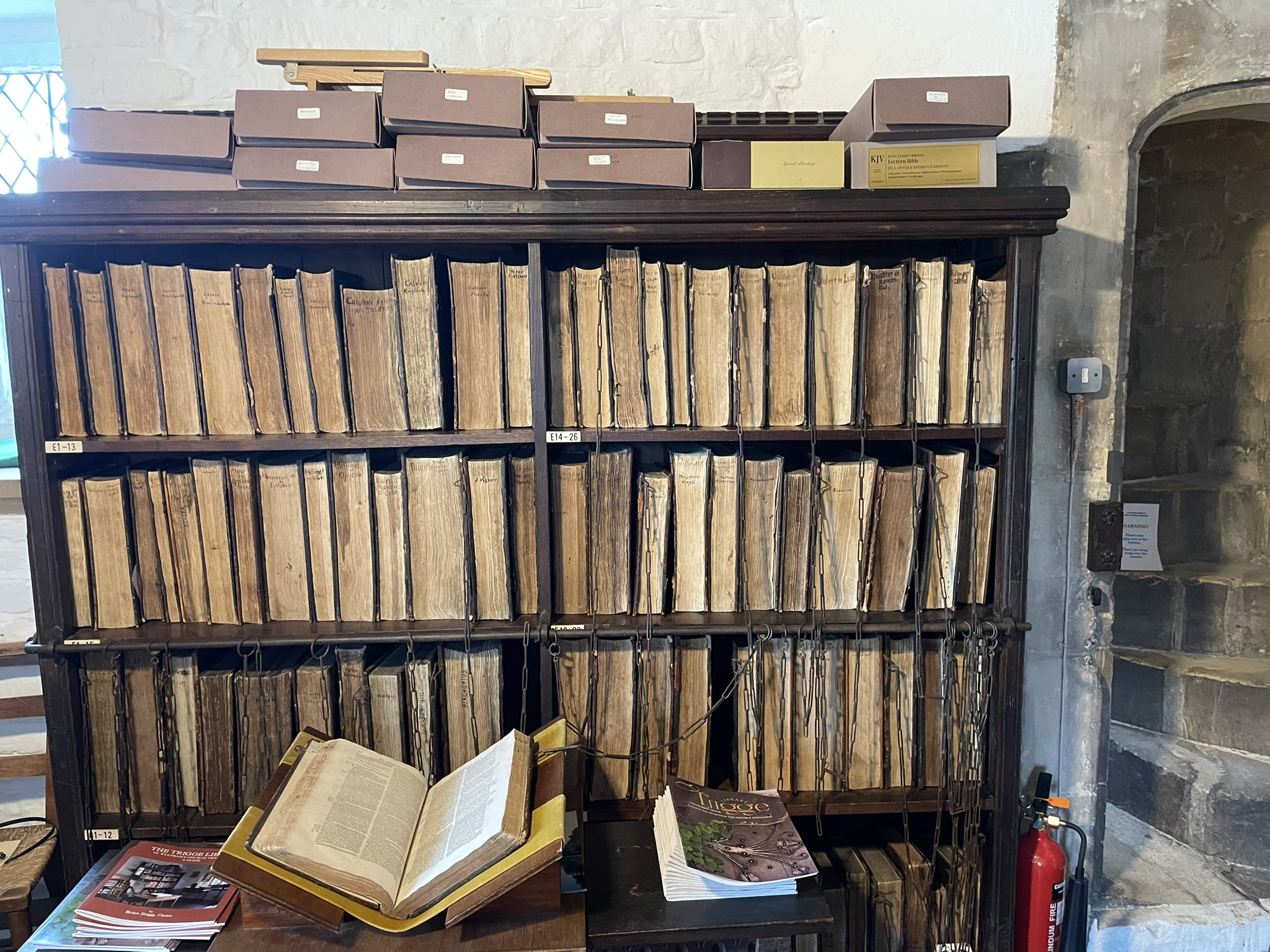
We were soon inside the relative cool of the nave of St Wulfram’s church – the West door was fully opened allowing the ambient temperature outside to make the inside a pleasant shady space. With time fast approaching midday and the closure of the unique Trigge Library, we squeezed up the 22 stone steps to the chained library in a room above the South Porch, opened for the people of Grantham and the local clergy in 1598AD, funded by £100 donation from the Rector of Welbourn, Francis Trigge a former Oxford Scholar and radical thinker – who felt books and learning should be made available to all those who could read. Isaac Newton, a pupil at nearby The King’s School probably used the volumes at some point.
The room is lined with bookshelves constructed in 1884 made from the original reading desks. The rather delicate iron chains were made by a local blacksmith and are still attached to 80 of the books. They are placed spine first on the shelves. The library has always been located in St Wulfram’s church in this room. In ancient times there were 3 keyholders: Rector, Burgher (mayor) and Headmaster.
There are 356 separate items including a book printed by Wendelin von Speyer in Venice in 1472AD, that is four years before Caxton introduced printing into England. (The Gutenberg Bible, Mainz was printed in 1455AD – the earliest European printed book). The book was written by Lanfranc do Oriano, a notable 15th century jurist. He transcribed the case reports with commentary for law students. It gives caselaw examples of trials e.g. a land dispute that sided in favour of the complainant objecting to a neighbour’s extension which would have blocked sunlight from his premises. Some things don’t change… It is printed on high quality rag paper and bound in leather. It is one of 26 examples known to exist today.
Another book printed in Antwerp in 1567 by Christophe Platin, taking 4 years to compile and print was the Antwerp Polyglot Bible, written in 5 languages : Hebrew, Greek, Latin, Aramaic and Syriac. Platin gained financial support from King Phillip II of Spain on the agreement that Benito Arias Montano would ‘edit’ the text of any ‘heretical’ thinking. 1, 200 paper printed sets of volumes and 10 sets on vellum were produced. Although 200 sets were lost when a galleon was sunk at sea.
They have several volumes of the Historia Animalium printed by Christophe Froschauer around 1551-8 written by Conrad Gessener, the city physician in Zurich in 1554. He is better known for his interest in natural history, bibliography and philology. The historia animalium was an encyclopaedia of all known animals species in the world at that time. The work is richly illustrated with woodcuts.
In his final decade, Gessener compiled an historia plantarum, which was unfished at his death in 1565, and eventually printed posthumously in 1754. It is an encylopaedia of all known plants.
St Wulfram’s parish church is huge, more akin to a cathedral. It boast the 3rd tallest spire in England and home to nesting peregrine falcons (not visible on our visit). We believe the association with the French missionary Saxon saint dates back to the link with Crowland Abbey, as the relic arm of the saint came to rest in Grantham when fire destroyed the abbey. Wulfram was born in France 650 AD, son of a high ranking Frankish soldier schooled in the court of King Clovis. He took holy orders and preached Christianity in Frisia (northern Germany today) becoming the Archbishop of Sens in 693. Dying in 720AD he was later canonised. Prior to the Reformation there was a shrine in the crypt to St Wulfram, his relics were lost during the changes brought about by the Reformation under Henry VIII.
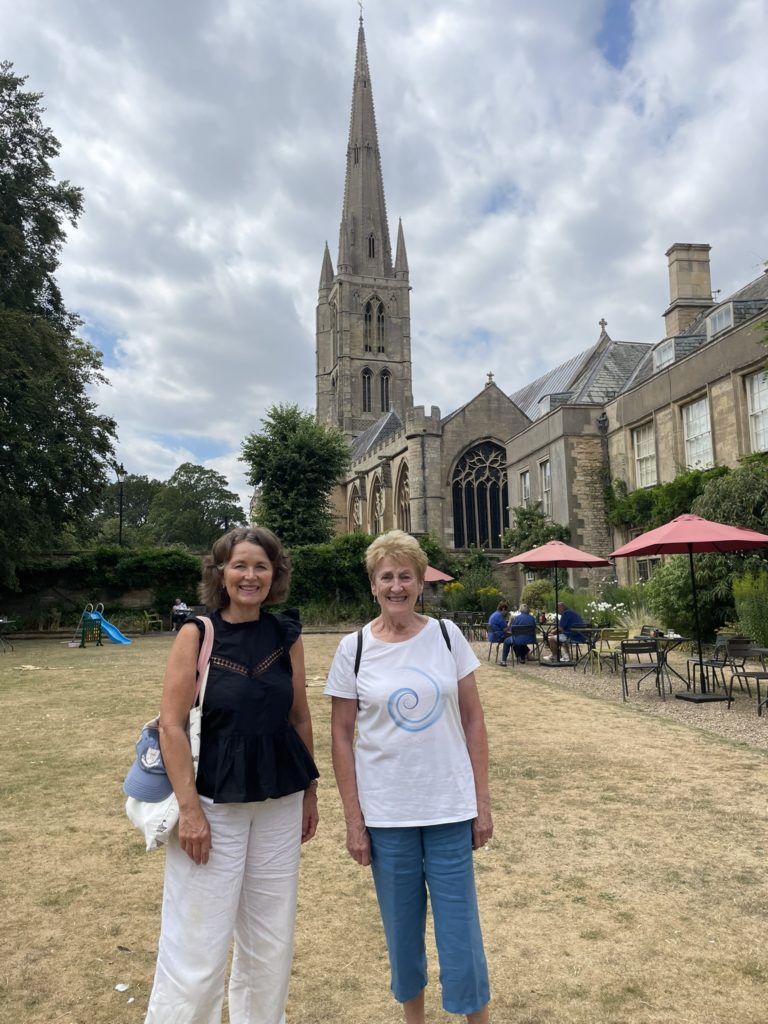
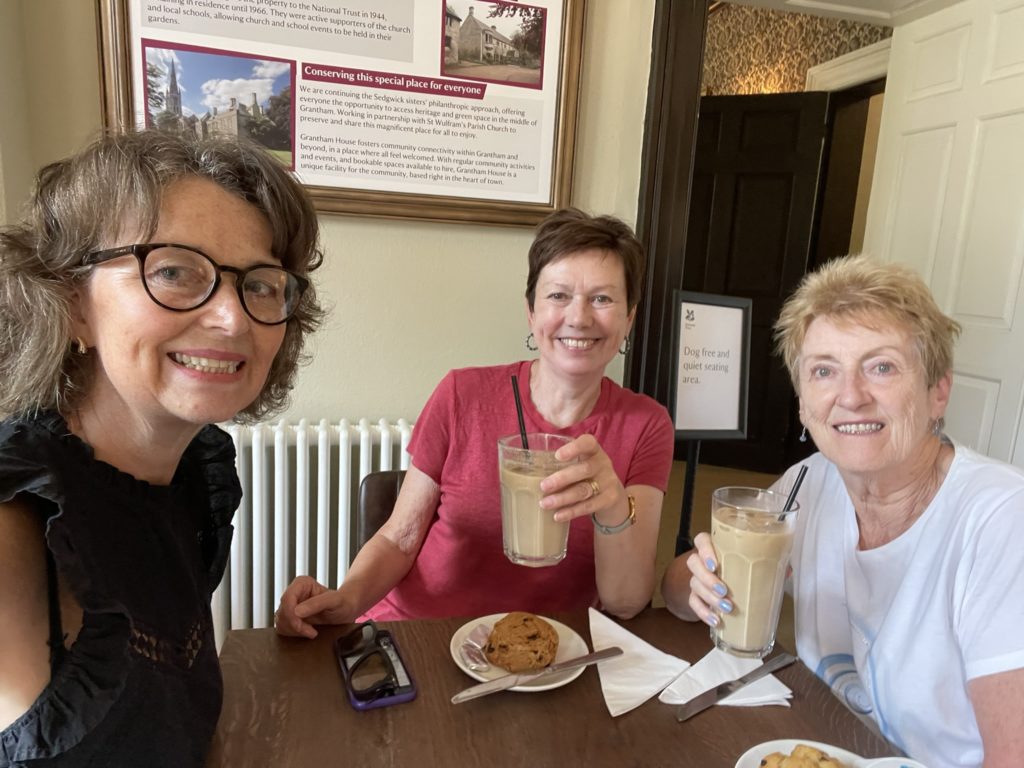
Leaving the nave and our kindly Trigge library volunteer guides to the organist and her (loud) practise we headed for Grantham House opposite where scones and tea awaited us in the cool inside cafe.
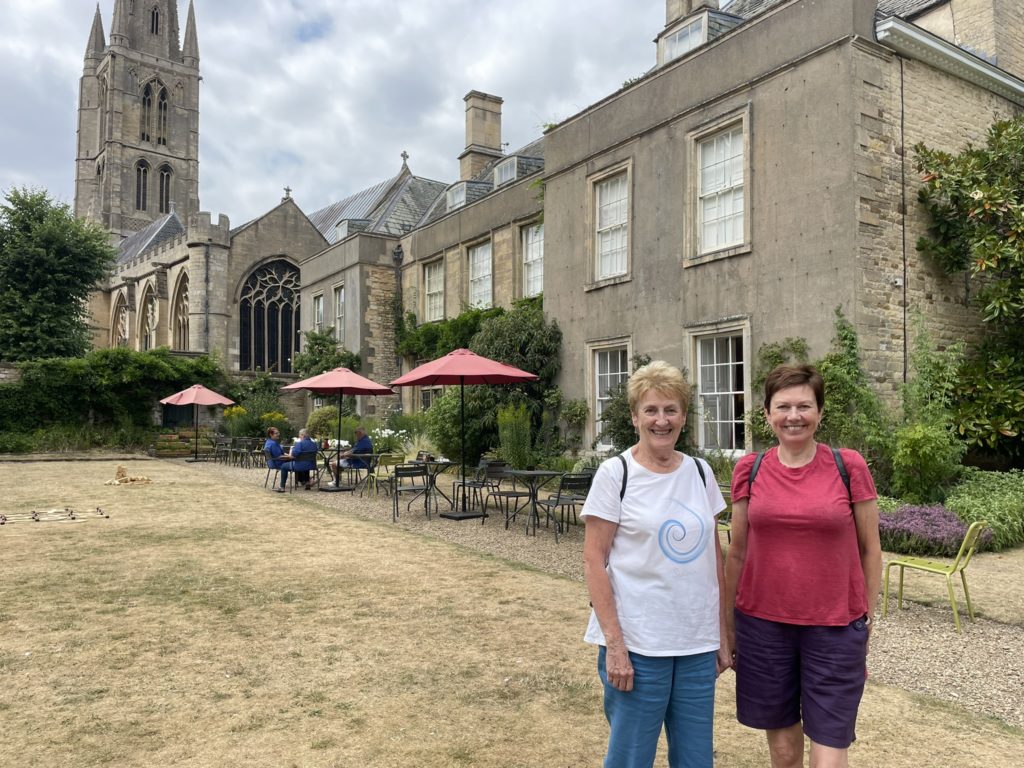
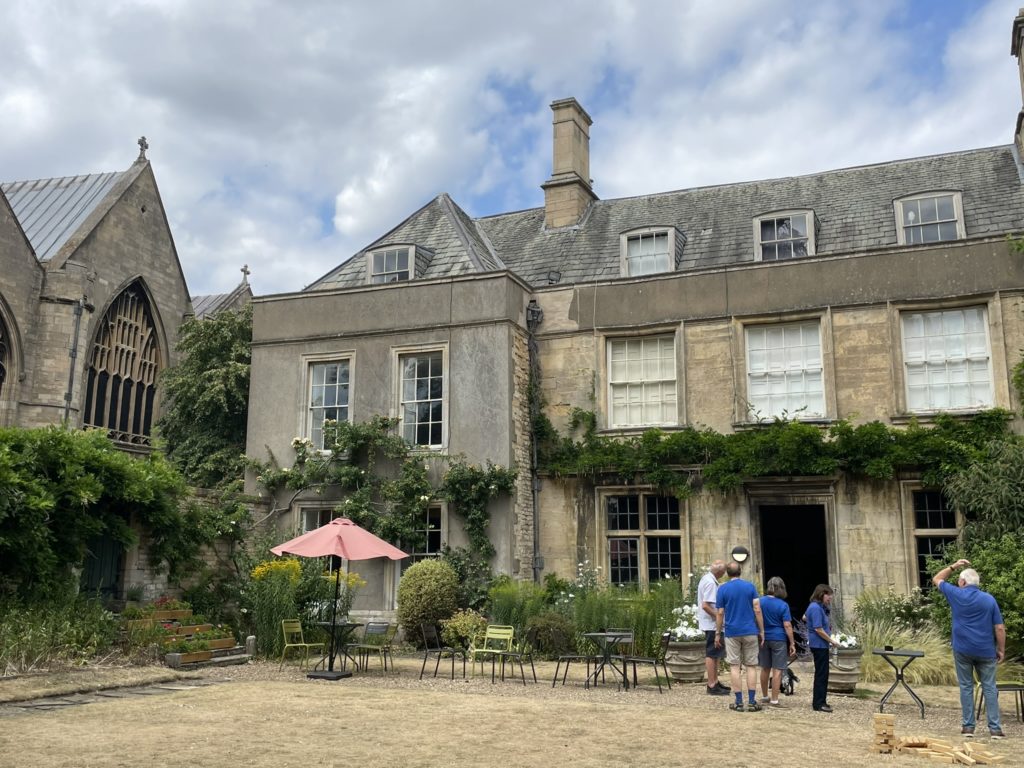
Built for Thomas Hall in 1350AD , a very wealthy wool merchant, this gem of a building in its walled grounds is a superb originally Medieval Town House, with Tudor and Georgian additions. In the historic quarter of Grantham it survives as an oasis for locals and nature alike. Now owned and run by the NT, it is free and open to everyone all year round – daily in the summer.
Princess Margaret Tudor (later Mary Queen of Scots) and Cardinal Wolsey both stayed here.
The garden is beautiful with majestic old trees, lawns, and wild areas adjacent to formal flower beds. We especially admired an enormous bramble growing amongst a willow tree. Bizarre but true.